

Linseed (Flax) Protein Isolate Market Forecast 2026–2036: Global Market to Reach USD 780.0 Million by 2036 at 9.8% CAGR
Linseed (Flax) Protein Isolate Market
Linseed (Flax) Protein Isolate Market accelerates as allergen-free demand and oilseed valorization boost food, beverage, and clinical nutrition global use.
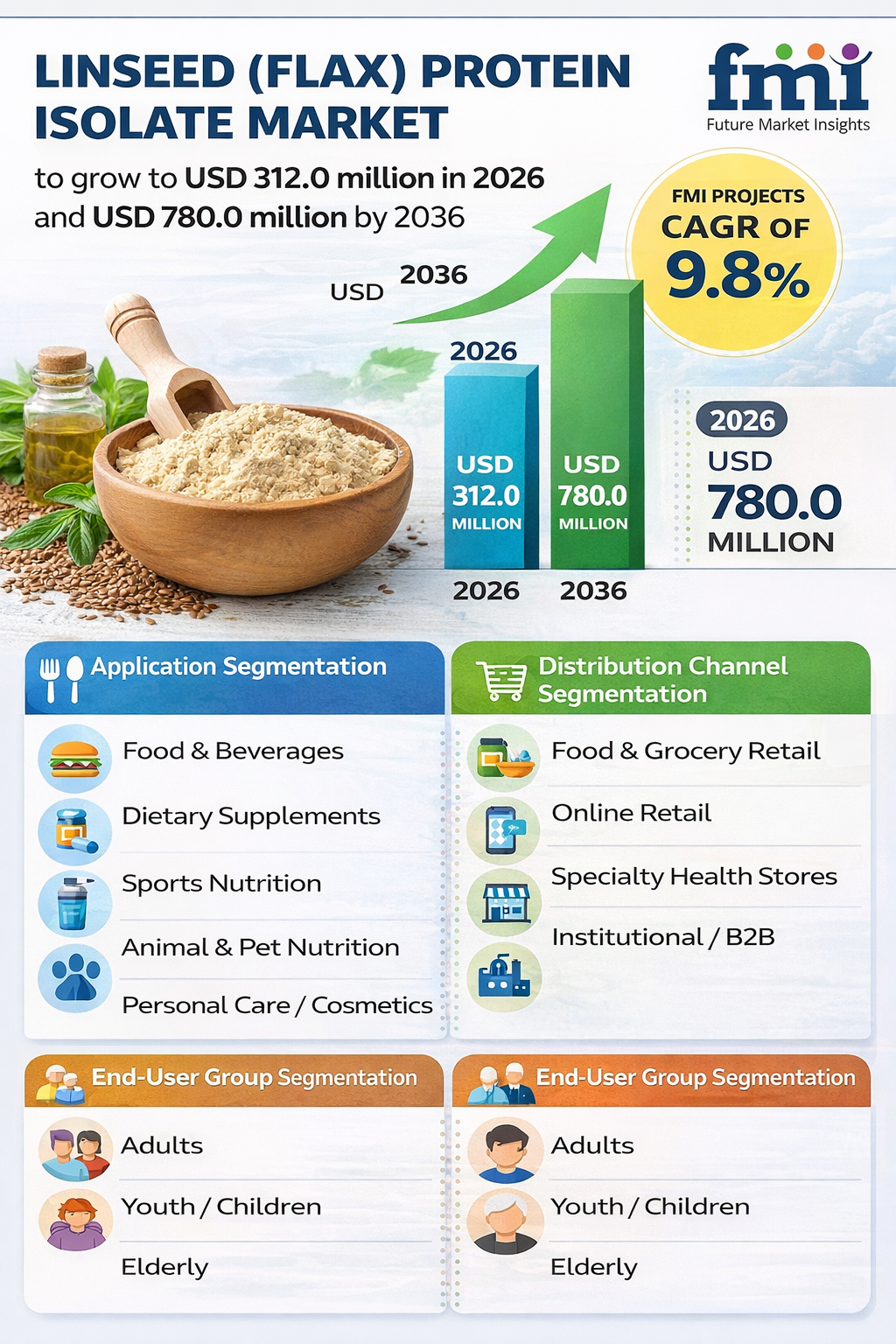
NEWARK, DE, UNITED STATES, February 27, 2026 /EINPresswire.com/ -- The global linseed (flax) protein isolate market is entering a decisive growth cycle as food and beverage manufacturers intensify the search for allergen-free, high-performance botanical proteins. In 2025, the market surpassed USD 290.0 million and is projected to grow to USD 312.0 million in 2026. According to analysis by Future Market Insights (FMI), the industry is expected to reach USD 780.0 million by 2036, expanding at a CAGR of 9.8%.
An absolute dollar opportunity of USD 468.0 million over the forecast period signals a structural shift toward premium plant-based fortification. Ingredient procurement teams are increasingly prioritizing highly purified isolates that offer strong dispersibility and neutral sensory performance, allowing brands to avoid texture degradation in beverages and dairy alternatives.
Request For Sample Report | Customize Report | Purchase Full Report - https://www.futuremarketinsights.com/reports/sample/rep-gb-32117
FMI’s latest assessment identifies flax protein isolate as a structurally underleveraged asset within the alternative protein ecosystem. Historically valued for its oil fraction, flaxseed is now entering a second commercialization cycle driven by protein valorization and zero-waste processing models. Manufacturers investing in integrated oil-and-protein recovery systems are positioning themselves for long-term competitive advantage.
Market Definition and Scope
Linseed (flax) protein isolate refers to highly purified botanical protein extracts derived from defatted flaxseed meal, typically exceeding 85% protein purity. These isolates are designed for food-grade and pharmaceutical-grade applications across functional foods, sports nutrition, and clinical formulations.
Inclusions:
Refined, food-grade and pharmaceutical-grade flax protein isolates supplied through B2B industrial agreements.
Exclusions:
Whole flaxseed, flax meal, concentrates below isolate purity, flax oil, omega extracts, and finished retail products.
Key Market Metrics
• Industry Size (2026): USD 312.0 Million
• Industry Value (2036): USD 780.0 Million
• CAGR (2026–2036): 9.8%
• Absolute Dollar Growth: USD 468.0 Million
Segmental Insights
By Form:
Isolate powder dominates with a 63% share in 2026, reflecting its shelf stability, dosing precision, and compatibility with global supply chains. Low-moisture powder formats minimize microbial risks and comply with strict beverage and clinical safety audits. Expansion in spray-drying infrastructure is reinforcing this dominance.
By Application:
Food & Beverages account for 44% of total demand in 2026. Reformulation across dairy alternatives, bakery, and protein beverages is accelerating adoption as brands seek allergen-free labeling advantages over soy and wheat derivatives.
Demand Drivers
1. Allergen Avoidance: Increasing consumer sensitivity to soy and gluten is pushing formulators toward neutral botanical isolates.
2. Government-Led Oilseed Processing: Domestic value-addition policies are encouraging integrated crushing and protein extraction infrastructure.
3. Clinical Nutrition Growth: High solubility and amino acid density make flax isolates suitable for medical nutrition applications.
Nandini Roy Choudhury, Principal Consultant for Food & Beverage at Future Market Insights, states, “Flax protein is transitioning from an overlooked oilseed byproduct to a high-value functional ingredient. Companies investing in advanced fractionation and debittering technologies will position flax as a credible challenger to pea and soy proteins in premium portfolios.”
Regional Outlook
South Asia:
India leads global growth with an 11.2% CAGR through 2036, supported by agricultural value-addition reforms and strong linseed cultivation. Localized extraction hubs are reducing import dependency and stabilizing procurement costs.
East Asia:
China is forecast to grow at 10.7% CAGR, driven by demand for sensory-optimized plant proteins. Manufacturers are investing in proprietary extraction systems to enhance solubility and remove off-notes.
North America:
The United States is projected to expand at 9.8% CAGR as allergen-free reformulation gains traction. Increased flax acreage and local crushing capacity support upstream alignment.
Europe:
The United Kingdom (9.3%) and Germany (9.0%) are strengthening domestic sourcing strategies amid geopolitical trade volatility. Clean-label compliance and supply chain transparency remain top procurement priorities.
Latin America:
Brazil is expected to register 8.8% CAGR, leveraging strong agricultural infrastructure to transition from raw commodity exports toward higher-value ingredient processing.
Market Dynamics
While demand momentum remains robust, sensory performance continues to influence adoption velocity. Bitter notes and limited aqueous solubility in unrefined fractions can slow beverage integration. Leading processors are responding with advanced enzymatic treatments and debittering technologies to meet strict formulation benchmarks.
Simultaneously, capital consolidation is reshaping competitive landscapes. Major ingredient conglomerates are expanding plant-based portfolios through strategic acquisitions, strengthening global distribution networks and accelerating commercialization timelines.
Competitive Landscape
Key players operating in the linseed (flax) protein isolate market include:
• Burcon NutraScience
• Ingredion Incorporated
• Roquette Frères
• Louis Dreyfus Company
• Danone
• Nestlé Health Science
• FrieslandCampina Ingredients
• BASF SE
Companies with diversified sourcing networks and proprietary sensory optimization capabilities are securing high-margin clinical and beverage contracts.
Research Methodology
FMI’s findings are based on first-hand corporate production data, structured interviews with processors and formulation scientists, customs trade analysis, agricultural output reports, and bottom-up capacity modeling. The study relies exclusively on verified industrial benchmarks with zero dependence on speculative third-party research.
Explore FMI’s Extensive Coverage in the Food and beverage Domain:
Melatonin Supplements Market: https://www.futuremarketinsights.com/reports/melatonin-supplements-market
Salmon Fish Market: https://www.futuremarketinsights.com/reports/salmon-fish-market
Asparagus Market: https://www.futuremarketinsights.com/reports/asparagus-market
Non-fat Dry Milk Market: https://www.futuremarketinsights.com/reports/non-fat-dry-milk-market
Protein Puddings Market: https://www.futuremarketinsights.com/reports/protein-puddings-market
About Future Market Insights (FMI)
Future Market Insights, Inc. (FMI) is an ESOMAR-certified, ISO 9001:2015 market research and consulting organization, trusted by Fortune 500 clients and global enterprises. With operations in the U.S., UK, India, and Dubai, FMI provides data-backed insights and strategic intelligence across 30+ industries and 1200 markets worldwide.
Sudip Saha
Future Market Insights Inc.
+ +1 347-918-3531
email us here
Legal Disclaimer:
EIN Presswire provides this news content "as is" without warranty of any kind. We do not accept any responsibility or liability for the accuracy, content, images, videos, licenses, completeness, legality, or reliability of the information contained in this article. If you have any complaints or copyright issues related to this article, kindly contact the author above.
