

Spirulina Beverages Market Outlook 2026–2036: Global Market to Reach USD 139.21 Million by 2036 at 14.3% CAGR
Spirulina Beverages Market
Spirulina beverages gain traction as functional, clean-label drinks, driven by health trends, natural energy demand, and innovation in taste and formats.
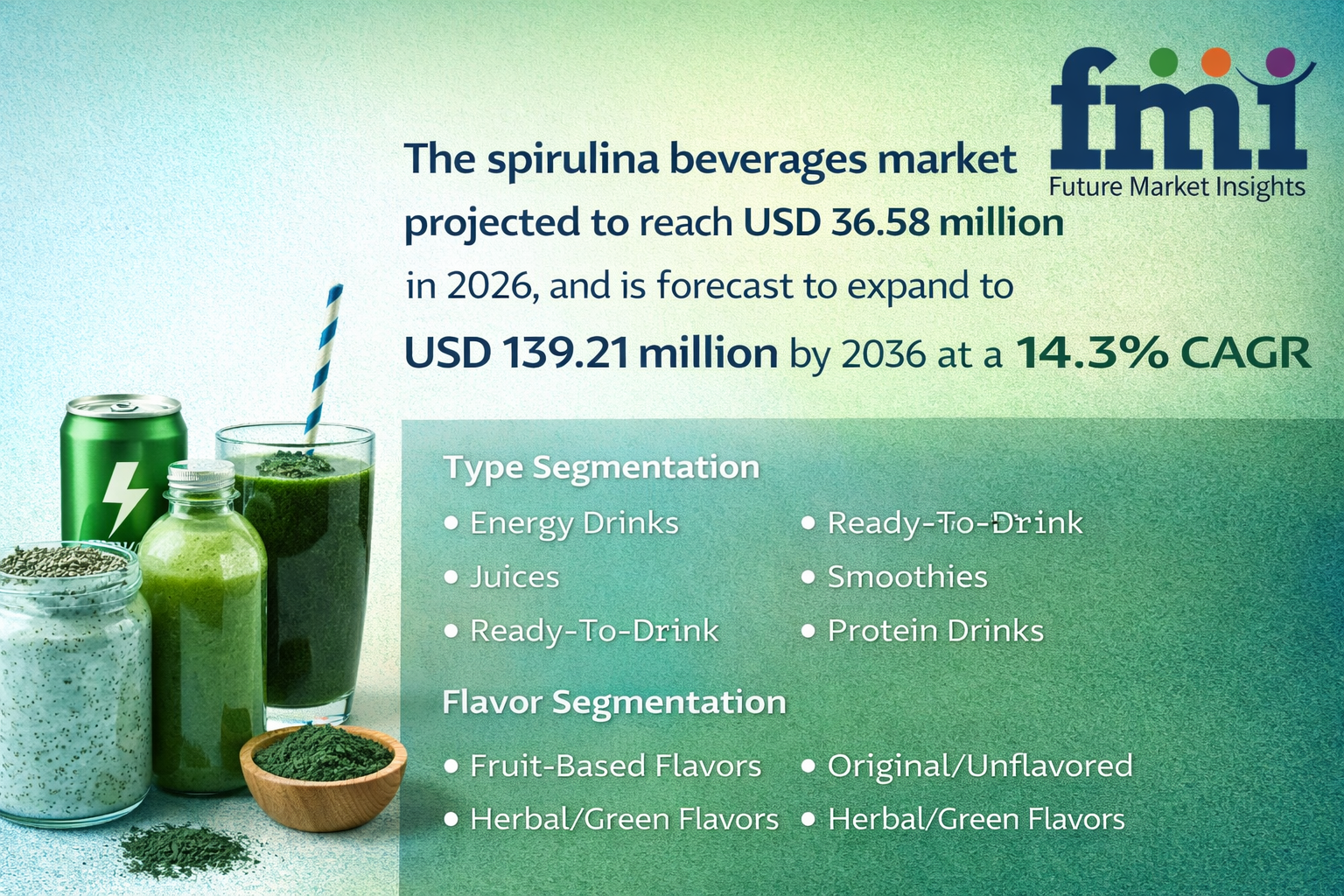
NEWARK, DE, UNITED STATES, March 17, 2026 /EINPresswire.com/ -- According to analysis by Future Market Insights (FMI), the global spirulina beverages market is entering a high-growth phase as functional beverage manufacturers accelerate the integration of superfood ingredients into ready-to-drink (RTD) formats.
The market was valued at USD 32.00 million in 2025 and is projected to reach USD 36.58 million in 2026. Over the forecast period, demand is expected to expand at a robust CAGR of 14.3%, ultimately reaching USD 139.21 million by 2036.
This rapid expansion reflects a structural shift in consumer consumption patterns, where spirulina is transitioning from a capsule-based supplement into a beverage-format delivery system. Its complete protein profile, natural blue-green pigmentation, and antioxidant properties enable beverage manufacturers to achieve both nutritional functionality and visual differentiation in increasingly competitive retail environments.
To Explore Detailed Market Data, Segment-Wise Forecasts, and Competitive Insights, Request Sample Report! https://www.futuremarketinsights.com/reports/sample/rep-gb-20864
Spirulina Beverages Market Snapshot
• Market Value (2025): USD 32.00 Million
• Forecast Value (2036): USD 139.21 Million
• Forecast CAGR (2026–2036): 14.3%
• Leading Product Type: Energy Drinks (38.0%)
• Top Flavor Segment: Fruit-Based Flavors (51.0%)
• Leading Distribution Channel: Convenience Stores (51.0%)
• Fastest Growing Market: India
Superfood-to-Beverage Shift Reshaping Product Innovation
A primary growth driver in the spirulina beverages market is the migration of superfood consumption from supplement formats into everyday beverage occasions.
Consumers are increasingly seeking convenient, drinkable nutrition that integrates seamlessly into daily routines. Spirulina beverages transform a supplement dosing ritual into a refreshment experience, increasing consumption frequency while improving consumer compliance.
FMI analysts highlight that this transition is redefining how functional ingredients are commercialized—moving from niche health products to mainstream beverage categories.
Natural Energy Positioning Challenges Synthetic Alternatives
Spirulina is emerging as a key differentiator in the energy drink segment, which accounts for approximately 38.0% of market share in 2026.
Unlike traditional energy drinks that rely on synthetic caffeine, spirulina-based formulations leverage natural protein and B-vitamin content to deliver sustained energy. This positioning aligns with clean-label trends and appeals to consumers seeking plant-based, stimulant-free alternatives.
As a result, spirulina-infused energy drinks are creating a new sub-category within the broader functional beverage landscape.
Flavor Masking Becomes Critical to Consumer Adoption
Despite its nutritional advantages, spirulina’s natural algal taste presents a significant formulation challenge.
Fruit-based flavors, which command 51.0% of the market, play a critical role in masking this taste and enabling mainstream consumer acceptance. Citrus, berry, and tropical profiles are widely used to balance flavor while preserving the ingredient’s health benefits.
FMI notes that taste optimization remains a decisive factor in scaling the category beyond early adopters into mass-market consumption.
Convenience Retail Drives Market Accessibility
Convenience stores are projected to hold 51.0% of distribution share in 2026, reflecting the alignment between spirulina beverages and on-the-go consumption patterns.
Single-serve packaging formats cater to impulse purchasing behavior, particularly among urban consumers seeking quick, functional refreshment options during commutes and workday breaks.
Retailers are increasingly allocating shelf space to functional beverages, enabling greater exposure and trial among mainstream consumers.
Cost and Taste Constraints Shape Competitive Dynamics
While demand is accelerating, the market faces two structural challenges:
• High production costs due to controlled cultivation and processing requirements
• Taste barriers that limit repeat consumption among new users
These constraints create a dual imperative for manufacturers:
• Optimize flavor systems to improve palatability
• Scale production to reduce ingredient costs and achieve price competitiveness
Companies that successfully address these challenges are expected to capture disproportionate market share as the category matures.
India and China Lead Global Growth Momentum
Regionally, the spirulina beverages market is witnessing strong expansion across emerging economies.
Spirulina Beverages Market Growth by Country (2026–2036)
• India: 11.0%
• China: 10.0%
• United States: 9.5%
• Germany: 8.9%
• United Kingdom: 8.4%
• France: 5.8%
India leads growth, supported by established spirulina cultivation infrastructure and rising demand for health beverages. China follows closely, driven by rapid urbanization and increasing consumer focus on nutritional products.
Innovation in Formulation and Packaging Unlocking Opportunities
Advancements in product formulation and packaging are reshaping the competitive landscape.
Manufacturers are focusing on:
• Flavor engineering to enhance taste acceptance
• Sustainable and premium packaging formats
• Multi-functional formulations combining nutrition, energy, and visual appeal
Spirulina’s natural phycocyanin pigment further enables product differentiation by offering both coloration and antioxidant functionality in a single ingredient.
Key Players in the Spirulina Beverages Market
Leading companies operating in the global market include:
• Prolgae Spirulina Supplies Pvt. Ltd.
• Cyanotech Corporation
• FUL Foods, Inc.
• Sol-ti, Inc.
• RAW JUICERY INC
• PHYCOMANIA
• Buried Treasure Liquid Nutrients
• Wild Fuel
• Bitez of Love
These players are leveraging product innovation, clean-label positioning, and expanded distribution strategies to strengthen their market presence.
Market Outlook: Spirulina Beverages Move Toward Mainstream Adoption
The long-term outlook for the spirulina beverages market remains highly positive as consumer demand for plant-based, functional, and clean-label beverages continues to rise.
As manufacturers improve taste profiles and optimize pricing strategies, spirulina beverages are expected to transition from niche health products to mainstream functional drink options.
With strong growth momentum, increasing retail penetration, and ongoing innovation, spirulina beverages are poised to become a core segment within the next generation of functional beverage formulations.
Explore FMI’s Extensive Coverage in the Food and beverage Domain:
Fruit Snacks Market: https://www.futuremarketinsights.com/reports/fruit-snacks-market
Yogurt Market: https://www.futuremarketinsights.com/reports/yoghurt-market
Sunflower Protein Concentrate Market: https://www.futuremarketinsights.com/reports/sunflower-protein-concentrate-market
Phytosterol Market: https://www.futuremarketinsights.com/reports/phytosterols-market
Sudip Saha
Future Market Insights Inc.
+ +1 347-918-3531
email us here
Legal Disclaimer:
EIN Presswire provides this news content "as is" without warranty of any kind. We do not accept any responsibility or liability for the accuracy, content, images, videos, licenses, completeness, legality, or reliability of the information contained in this article. If you have any complaints or copyright issues related to this article, kindly contact the author above.
