

Surgical Robot Procedures Market Set for 17.3% CAGR Through 2033 | Persistence Market Research
surgical robot procedures market
The surgical robot procedures market is rapidly growing, driven by AI-enabled , robotic-assisted surgeries, and expanding global adoption across specialties.
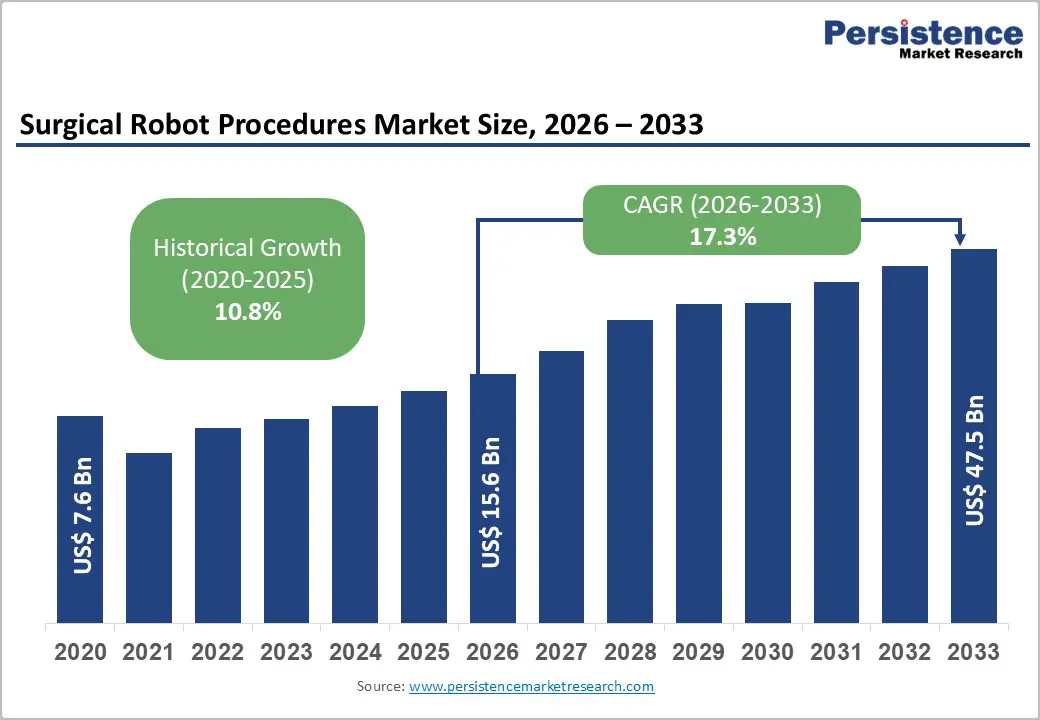
LONDON, UNITED KINGDOM, April 6, 2026 /EINPresswire.com/ -- The global surgical robot procedures market is entering a high-growth phase, driven by rapid adoption of minimally invasive techniques and evolving revenue models. The market is projected to reach US$ 15.6 billion in 2026 and expand to US$ 47.5 billion by 2033, registering a CAGR of 17.3%. This growth reflects increasing procedure volumes, expanding clinical applications, and a transition toward recurring revenue streams from consumables, software, and service contracts rather than one-time capital equipment sales.
Download Your Free Sample & Explore Key Insights: https://www.persistencemarketresearch.com/samples/36071
Drivers of Market Growth
A major factor supporting market expansion is the widespread adoption of robot-assisted laparoscopic procedures across specialties such as urology, gynecology, and general surgery. Hospitals are increasingly leveraging robotic systems to improve surgical precision, reduce recovery times, and enhance operational efficiency. Companies like Intuitive Surgical continue to report strong procedure growth, highlighting increased utilization of installed systems. Additionally, regulatory approvals from the U.S. Food and Drug Administration are expanding the range of surgical indications, encouraging adoption beyond large academic centers into community hospitals and ambulatory surgery centers.
Technological Advancements
The market is also benefiting from technological advancements, particularly in artificial intelligence-enabled navigation and imaging systems. These innovations reduce operating room staffing requirements and improve surgical workflows. AI-powered modules are increasingly being integrated into robotic platforms, enabling surgeons to perform procedures with greater autonomy and efficiency. Furthermore, the emergence of Robot-as-a-Service models is transforming procurement strategies by lowering upfront capital investment and shifting costs to operational expenditure, making robotic systems more accessible in middle-income markets.
Regional Insights
Regionally, North America is expected to dominate the market with approximately 44% share in 2026, supported by strong reimbursement frameworks and high system utilization rates. Europe follows with steady adoption driven by established healthcare infrastructure and regulatory compliance standards. Meanwhile, Asia Pacific is projected to be the fastest-growing region, fueled by rising healthcare investments, expanding private hospital networks, and increasing surgical demand in countries such as China and India.
Get Custom Insights Designed for Your Businecss: https://www.persistencemarketresearch.com/request-customization/36071
Specialty Analysis
From a specialty perspective, urology remains the leading segment, accounting for around 28% of market revenue in 2026. Procedures such as prostatectomy and nephrectomy have long benefited from robotic precision, resulting in strong surgeon familiarity and consistent demand. In contrast, orthopedics and spine surgery are expected to witness the fastest growth, driven by advancements in robotic alignment technologies and an aging global population requiring joint and spinal interventions.
Technology Segment Insights
Technologically, multi-arm surgeon-console systems dominate the market, contributing more than half of total revenue. These systems are widely adopted due to their versatility across multiple surgical disciplines and their established clinical outcomes. However, AI-enabled navigation systems are emerging as the fastest-growing segment, with significant potential to enhance efficiency and generate additional per-procedure revenue.
Market Challenges
Despite strong growth prospects, the market faces several challenges. High capital costs, regulatory complexities, and supply chain constraints remain key barriers to adoption. Tariffs and import duties in certain regions further increase system costs, slowing penetration in price-sensitive markets. Additionally, stringent regulatory requirements for software validation and cybersecurity are extending product development timelines and increasing compliance expenses for manufacturers.
Opportunities in Emerging Markets
Significant opportunities exist in expanding access to surgical care, particularly in low- and middle-income countries. Data from organizations like the World Health Organization highlights unmet surgical demand, underscoring the potential for scalable robotic solutions. Companies that focus on cost-effective models, localized manufacturing, and platform-agnostic software integration are likely to gain a competitive advantage.
Checkout Now & Download Complete Market Report: https://www.persistencemarketresearch.com/checkout/36071
Market Segmentation
By Specialty
Urology
Gynecology
General Surgery
Cardiothoracic/Cardiovascular
Orthopedics/Spine
Pediatrics
Others
By Technology
Multi-Arm Surgeon-Console Platforms
Modular/Portable Multi-Arm Systems
Single-Port/Single-Arm Platforms
AI-Enabled Navigation Modules
Others
By Business Model
Direct Capital Purchase
Lease/Rental
Robot-as-a-Service (RaaS)
Service & Maintenance Contracts
Others
By Region
North America
Europe
East Asia
South Asia & Oceania
Latin America
Middle East & Africa
Competitive Landscape
The competitive landscape remains concentrated among major players such as Medtronic, Johnson & Johnson, and Intuitive Surgical, which dominate the installed base and procedural volume. However, increasing competition from emerging firms and specialized technology providers is driving innovation and expanding the overall ecosystem.
Conclusion
The surgical robot procedures market is poised for substantial growth, supported by technological innovation, expanding clinical applications, and evolving business models. As healthcare systems prioritize efficiency, precision, and patient outcomes, robotic-assisted surgery is transitioning from a premium offering to a mainstream clinical necessity.
Read Related Reports:
Oral Macromolecular Formulation Market: The global oral macromolecular formulation market is valued at US$19.3B in 2026 and is projected to reach US$27.4B by 2033, growing at a 5.1% CAGR.
Cell Counting Market: The global cell counting market is set to grow from US$11.8 Bn in 2026 to US$19.4 Bn by 2033, driven by 6.1% CAGR and rising life science demand.
Persistence Market Research
Persistence Market Research Pvt Ltd
+1 646-878-6329
email us here
Visit us on social media:
LinkedIn
Instagram
Facebook
YouTube
X
Legal Disclaimer:
EIN Presswire provides this news content "as is" without warranty of any kind. We do not accept any responsibility or liability for the accuracy, content, images, videos, licenses, completeness, legality, or reliability of the information contained in this article. If you have any complaints or copyright issues related to this article, kindly contact the author above.
