

Nespresso Market to Reach USD 15.27 Billion by 2035 at 5.75% CAGR Driven by Sustainable Coffee Innovations
Nespresso Market
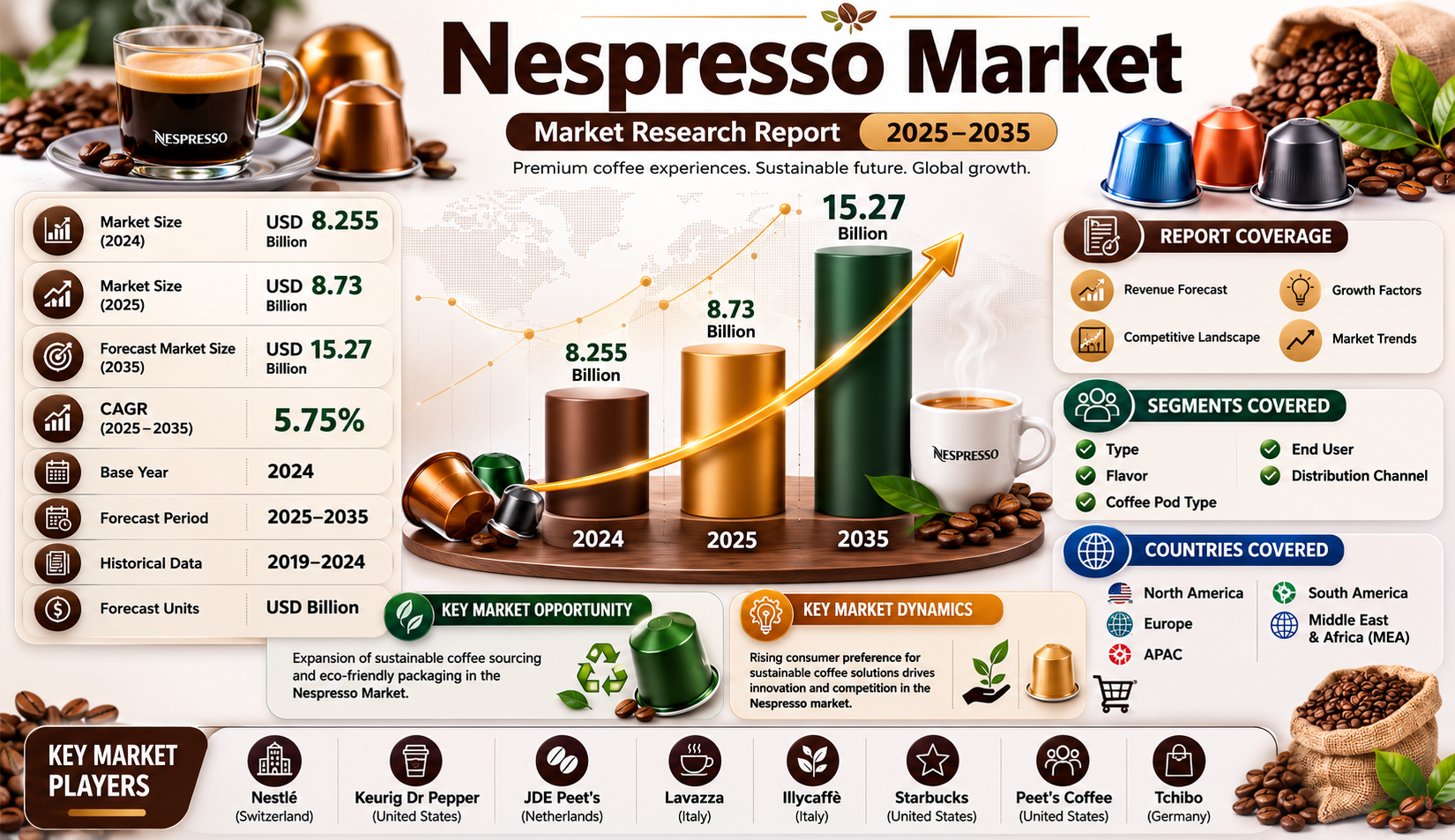
The Nespresso Market continues to evolve as premium coffee consumption becomes a lifestyle preference across households, offices, hotels, and commercial establishments. Consumers are increasingly seeking café-quality coffee experiences at home, encouraging the widespread adoption of coffee capsule systems that combine convenience, consistency, and premium taste. The growing popularity of specialty coffee, coupled with advancements in brewing technologies, has strengthened demand for Nespresso-compatible products worldwide. The market was valued at USD 8.255 Billion in 2024 and is projected to grow from USD 8.73 Billion in 2025 to USD 15.27 Billion by 2035, registering a 5.75% CAGR during the forecast period.
The expansion of the market is supported by rising disposable incomes, urbanization, changing consumer lifestyles, and increasing awareness regarding sustainable coffee sourcing. Coffee enthusiasts are showing greater interest in premium blends, single-origin varieties, and recyclable coffee capsules that minimize environmental impact while maintaining product quality. Manufacturers continue to invest in innovative capsule technologies, premium flavors, and environmentally responsible packaging to strengthen customer loyalty and expand their global footprint.
Competitive Landscape and Key Players
The competitive landscape remains highly dynamic as established coffee brands focus on innovation, premiumization, sustainability, and expanding distribution networks. Companies are investing in recyclable aluminum capsules, biodegradable pod materials, smart coffee machines, and digital customer engagement strategies to strengthen market presence. Strategic partnerships with coffee growers, retail expansion, subscription services, and online sales channels continue to shape industry competition.
Key companies operating in the market include Nestle (CH), Keurig Dr Pepper (US), JDE Peet's (NL), Lavazza (IT), Illycaffe (IT), Starbucks (US), Peet's Coffee (US), and Tchibo (DE). These industry participants continuously introduce new coffee blends, seasonal flavors, limited-edition collections, and eco-friendly packaging solutions to meet changing consumer expectations while expanding their international customer base.
One of the strongest drivers of the Nespresso Market is the growing consumer preference for sustainable coffee solutions. Environmental awareness has encouraged manufacturers to improve capsule recycling programs, adopt ethically sourced coffee beans, and reduce carbon emissions throughout their supply chains. Sustainability has become a significant purchasing factor, particularly among younger consumers who increasingly value environmentally responsible brands. As a result, companies are investing heavily in circular economy initiatives that enhance both brand reputation and long-term market growth.
Another important growth factor is the increasing penetration of smart kitchen appliances. Modern coffee machines now feature programmable brewing options, smartphone connectivity, automatic maintenance alerts, and customized brewing profiles that significantly improve user experience. Combined with subscription-based coffee delivery services, these technological advancements encourage repeat purchases and long-term customer engagement, contributing to sustained market expansion.
Free Sample Copy – Access A Complimentary Copy of Our Report to Explore Its Content and Insights
https://www.marketresearchfuture.com/sample_request/26764
Market Segmentation Analysis
By Type
Based on type, the market is segmented into Original Nespresso Capsules, Compatible Capsules, and Coffee Machines. Original capsules continue to maintain strong brand recognition due to their premium quality, consistency, and exclusive coffee blends. Compatible capsules are witnessing faster adoption because they offer affordability and broader flavor selections while remaining compatible with popular brewing systems. Coffee machines continue to experience stable demand as consumers increasingly upgrade to premium brewing equipment for home and workplace use.
By Flavor
The flavor segment includes Espresso, Lungo, Decaffeinated, Flavored Coffee, Single-Origin Coffee, and Specialty Blends. Espresso remains the dominant category owing to its traditional popularity and concentrated taste profile. However, flavored coffee varieties are gaining momentum as consumers experiment with vanilla, caramel, hazelnut, chocolate, and seasonal limited-edition offerings. Single-origin coffees are also attracting coffee enthusiasts seeking authenticity, traceability, and premium-quality beans sourced from renowned coffee-growing regions.
By Coffee Pod Type
Based on coffee pod type, the market includes Aluminum Capsules, Plastic Capsules, Compostable Pods, and Biodegradable Capsules. Aluminum capsules continue to dominate because they preserve coffee freshness while supporting established recycling programs. Meanwhile, compostable and biodegradable pods represent the fastest-growing category as environmental regulations and consumer awareness drive demand for sustainable alternatives. Continuous material innovation is expected to accelerate adoption of eco-friendly pod solutions during the forecast period.
By End User
The end-user segment comprises Residential, Commercial, Hospitality, Offices, and Food Service establishments. Residential consumers account for the largest share due to the growing trend of home coffee consumption and remote working environments. Commercial establishments such as cafés, hotels, restaurants, and corporate offices increasingly adopt premium capsule systems to provide consistent beverage quality while reducing preparation time and operational complexity.
By Distribution Channel
The market is segmented into Online Retail, Supermarkets & Hypermarkets, Specialty Stores, Brand Stores, and Other Retail Channels. Online retail continues to register significant growth as consumers increasingly prefer convenient ordering, subscription services, personalized recommendations, and doorstep delivery. Meanwhile, supermarkets and specialty stores remain important distribution channels by providing product visibility, promotional campaigns, and immediate product availability for consumers seeking premium coffee products.
Regional Analysis
North America remains a major market driven by strong coffee consumption habits, premium beverage preferences, advanced retail infrastructure, and increasing adoption of smart coffee machines. Consumers continue to embrace sustainable coffee capsules, subscription services, and premium home brewing solutions, supporting steady regional growth.
Europe represents one of the largest regional markets due to its mature coffee culture, high disposable incomes, and widespread acceptance of premium espresso-based beverages. Countries across the region continue to prioritize sustainable sourcing, recyclable packaging, and premium coffee experiences, making Europe a significant contributor to global market revenue.
The Asia-Pacific region is expected to register the fastest growth throughout the forecast period. Rapid urbanization, expanding middle-class populations, rising café culture, increasing disposable income, and growing awareness of premium coffee products are creating substantial growth opportunities across emerging economies. Digital commerce platforms further accelerate product accessibility throughout the region.
South America continues to benefit from its position as a major coffee-producing region while simultaneously experiencing rising domestic premium coffee consumption. Increasing investments in branded coffee products and premium brewing systems support long-term market development across several countries.
The Middle East and Africa are witnessing gradual market expansion due to rising hospitality investments, luxury lifestyle trends, premium retail development, and increasing consumer preference for specialty coffee experiences. Growing tourism and commercial infrastructure projects are further supporting demand for premium capsule coffee solutions.
The future outlook for the Nespresso Market remains highly promising as sustainability, premiumization, digital commerce, and product innovation continue to reshape consumer purchasing behavior. Manufacturers are expected to prioritize recyclable packaging, ethical sourcing practices, personalized coffee experiences, and advanced brewing technologies to maintain competitive advantages. Continuous investments in flavor innovation, subscription-based business models, and expanding distribution networks will further strengthen market growth through 2035 while meeting the evolving expectations of environmentally conscious coffee consumers.
Frequently Asked Questions
Q1. What is driving the growth of the Nespresso Market?
The market is primarily driven by increasing demand for premium coffee experiences, rising adoption of coffee capsule systems, sustainable packaging initiatives, expanding online retail channels, and continuous product innovation in coffee machines and capsules.
Q2. Which region is expected to experience the fastest growth during the forecast period?
The Asia-Pacific region is anticipated to witness the fastest growth due to rapid urbanization, expanding middle-class populations, increasing disposable income, growing café culture, and rising demand for premium coffee products.
Read Our Related Research Report
RTD Coffee Market –
https://www.marketresearchfuture.com/reports/rtd-coffee-market-11613
Espresso Coffee Market –
https://www.marketresearchfuture.com/reports/espresso-coffee-market-24586
Coffee Extract Market –
https://www.marketresearchfuture.com/reports/coffee-extract-market-23340
Instant Coffee Market –
https://www.marketresearchfuture.com/reports/instant-coffee-market-7834
Food Service Coffee Market –
https://www.marketresearchfuture.com/reports/foodservice-coffee-market-11882
Sagar Kadam
Market Research Future
+ +1 628-258-0071
email us here
Legal Disclaimer:
EIN Presswire provides this news content "as is" without warranty of any kind. We do not accept any responsibility or liability for the accuracy, content, images, videos, licenses, completeness, legality, or reliability of the information contained in this article. If you have any complaints or copyright issues related to this article, kindly contact the author above.
